How to identify the exact version of a Japanese Pokémon card
The short answer
Read four things on the card, in this order: the set code, the card number, the rarity code, then the foil. The first three sit in the bottom left of a modern Japanese card and pin down the card. The foil decides which version you hold, and in a set like Pokémon Card 151 (ポケモンカード151, SV2a) it is most of the price: on 3 Oct 2026 Card Rush asked ¥280 for the plain Pikachu 025/165, ¥1,780 for its Poké Ball mirror and ¥69,800 for its Master Ball mirror. All three carry the same number.
This post is the checklist. Our rarity guide explains what each rarity code means, and the beginner's guide covers eras and fakes.
1. The set code and the regulation mark
The official rules page puts both in the bottom left. The expansion mark (エキスパンションマーク) says which product the card came from; the regulation mark (レギュレーションマーク) is a single letter that decides whether you can play the card in tournaments. The Pokémon Company prints regulation marks on cards from Sun & Moon onwards. On XY BREAK and older cards the expansion mark sits in the bottom right instead.
For a collector the set code matters more than the letter. SV2a is 151, SV8a is Terastal Festival ex (テラスタルフェスex). The letter only tells you whether the card is legal: since 23 Jan 2026 the Standard format takes cards marked H, I and J, according to the official rules page. That matters mainly for cards people buy to play.
2. The card number and the set total
Next to the set code you'll find two numbers, such as 201/165. The first is the card's place in the list. The second is the size of the main set. A Japanese guide, Sangatsu Usagi, explains that the high rarities get numbers above the total because they sit outside the main list.
The official card database shows this for 151. Charizard ex appears three times: 006/165 as RR, 185/165 as SR and 201/165 as SAR. Our data has 210 cards in a set whose official total is 165, so 45 numbers sit above it.
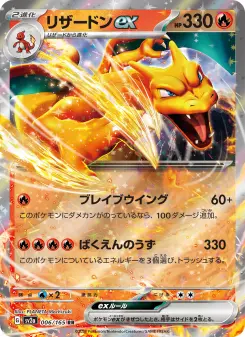
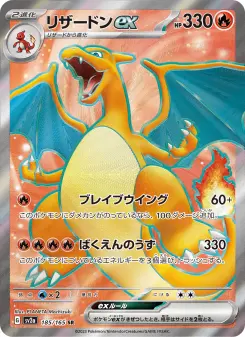
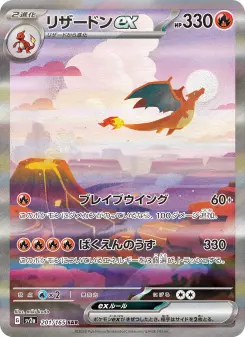
| Card | Number | Rarity | CardMochi price, 3 Oct |
|---|---|---|---|
| Charizard ex | 006/165 | RR | ¥680 |
| Charizard ex | 185/165 | SR | ¥5,480 |
| Charizard ex | 201/165 | SAR | ¥62,800 |
Same Pokémon, same set, and a 92-fold gap between the cheapest and the dearest. Buy by name alone and you can pay ¥62,800 for a ¥680 card, or the other way round. Always quote the number.
3. The rarity code
Next to the number is a short code: C, U, R, RR, AR, SR, SAR, UR, MUR, ACE and others, depending on the era. The official card search shows it as an icon beside the number. The codes aren't the English names: Sangatsu Usagi describes the Japanese UR as a gold card, not what English sets call an Ultra Rare. The rarity guide has the full table, so we won't repeat it here.
The code confirms the number. If a listing says SAR but the number sits inside the set total, something is wrong.
4. The foil: mirrors, Poké Balls and Master Balls
In some sets this step decides most of the price. A mirror card (ミラー) is a C, U or R card with a foil finish. It shares its number with the plain card, so number and rarity can't tell them apart. You have to look at the foil.
Some sets add patterned mirrors. The official 151 page promises, alongside the normal cards, "luxury mirror" cards with a special Poké Ball pattern (モンスターボール柄). Collectors also hunt a rarer Master Ball pattern (マスターボール柄). Gamepedia (攻略大百科), a Japanese strategy site, says every 151 box holds exactly one Master Ball mirror. It adds that only C, U and R cards get them, and that Terastal Festival ex, released 6 Dec 2024, brought a new batch. Sangatsu Usagi dates the Poké Ball mirror back to Incandescent Arcana (白熱のアルカナ) in 2022. Tilt the card under a light: Gamepedia's guide says the ball shapes show up in the foil.
Here is what the shops asked for the three versions of the same number on the morning of 3 Oct 2026:
| Card | Number | Plain | Poké Ball mirror | Master Ball mirror |
|---|---|---|---|---|
| Pikachu | 025/165 | ¥280 | ¥1,780 | ¥69,800 |
| Gengar | 094/165 | ¥780 | ¥2,480 | ¥99,800 (sold out) |
| Mewtwo | 150/165 | ¥280 | ¥980 | ¥19,800 |
| Umbreon | 092/187 | ¥280 | ¥1,480 | ¥19,800 |
Card Rush asking prices from the listing pages our scanner saved on 3 Oct 2026; "plain" is the listing with no finish tag. Yuyu-tei asked ¥79,800 for the Master Ball Pikachu and ¥19,800 for the Master Ball Umbreon on the same morning.


Across all 153 numbers in 151 that come in all three finishes, the median Card Rush ask was ¥80 for the plain card, ¥180 for the Poké Ball mirror and ¥1,580 for the Master Ball mirror. The Master Ball version typically asked 27 times the plain one. In Terastal Festival ex the gap is smaller: a median ratio of 7 at Card Rush across the 101 numbers listed in all three finishes. Sometimes the pattern counts for more than the Pokémon: a Master Ball Psyduck (コダック) at ¥20,800 asked more than the Charizard ex SR.
5. Promos
Promo cards (プロモ) come from events, magazines and product bonuses, not booster packs. Sangatsu Usagi gives two tells: a PROMO mark, or a "-P" after the series code where a set code would be, as in SV-P. They have their own numbering, so a promo Pikachu and a 151 Pikachu are different cards. The Detective Pikachu promo SV-P 098 asked ¥34,800 at both Card Rush and yuyu-tei on 3 Oct.
6. First edition, for vintage cards
Modern Japanese cards carry no edition mark, so you can skip this step for anything printed from Sun & Moon onwards. Older cards are different. The buy-back guide Saikoune and a SNKRDUNK article agree on two marks:
- Old-back cards (旧裏, 1996 to about 2001): a first print of the first expansion has no rarity symbol in the bottom right, where later prints show a ★, ◆ or ● (Sangatsu Usagi lists the three). SNKRDUNK warns that promos and some other cards also lack the symbol, so a missing star alone doesn't prove a first print.
- From the ★VS and e-series (2001) to XY: first prints carry a "1ED" mark, Saikoune says. Sun & Moon and later cards have none.
Saikoune warns that fakes and altered marks exist and advises having a valuable card checked by a specialist shop or a grader.
7. Japanese or English
The back and the text tell you the language, but the numbers can mislead. English sets have their own codes and sometimes their own numbering. In our data, from the TCGdex card database, the English 151 Charizard ex special illustration rare is 199/165, not 201/165. Gamepedia also notes that the English 151 has no Master Ball mirrors. A Japanese card and its English counterpart are separate markets, so never price one from the other's sales.
How this maps to CardMochi
A CardMochi Pokémon card is one set code plus one number, for example SV2a-025. Japanese and English prints are separate records labelled JP and EN. The price we show is the cheapest asking price for the plain version at Card Rush and yuyu-tei. Our scanner matches the plain listing and skips the mirror and ball-pattern versions, so for Pikachu 025 we show ¥120 (yuyu-tei), not ¥69,800. We don't price mirror versions separately yet, though the 151 set page notes that collectors treat them as cards of their own.
Sold prices follow the same rule: we show a Yahoo! Auctions median only where we trust the version match. For the Charizard ex SAR 201/165 that was ¥41,750 over 42 sales in 90 days, about two-thirds of the ¥62,800 ask.
What this means for you
- Buying: put the full code in your search, such as "SV2a 025 マスターボールミラー". Japanese shops write the finish in brackets after the name, and in 151 that tag alone lifts the median Card Rush ask 27-fold.
- Selling or sorting a binder: check every C, U and R card from 151 and Terastal Festival ex for a ball pattern before you sell it as bulk.
- Tracking: add cards to the collection tracker by number. If you own a mirror, note it yourself for now.
Method and limits
- Prices are asking prices (what shops charge), not sales. For the 16 cards in 151 with a trusted Yahoo! Auctions match, the median sold price was about 65% of the ask.
- The finish table comes from the Card Rush and yuyu-tei listing pages our price scanner saved early on 3 Oct 2026, read with the same parser the site uses; the site itself shows only the plain version. Medians include sold-out listings.
- The two shops list 101 Master Ball mirrors under SV8a, while Gamepedia counts 144 cards with one. We haven't resolved the difference.
- Pull rates (one Master Ball mirror a box in 151, about one in two boxes in Terastal Festival ex) are Gamepedia's figures, not official.
Sources
- The Pokémon Company, regulation rules, expansion and regulation marks, Standard from 23 Jan 2026: pokemon-card.com/rules/regulation
- Official card database, Charizard ex SV2a 006/165 RR: pokemon-card.com; 185/165 SR: pokemon-card.com; 201/165 SAR: pokemon-card.com
- Pokémon Card 151 product page, Poké Ball pattern mirrors: pokemon-card.com/ex/sv2a
- Terastal Festival ex product page, 6 Dec 2024: pokemon-card.com/ex/sv8a
- Sangatsu Usagi (三月うさぎ), rarity guide: card layout, numbers above the total, UR, mirrors, promos, old-back marks (★ ◆ ●): sangatuusagi.com
- Gamepedia (攻略大百科), Master Ball mirrors: how to tell them apart, rates, Terastal Festival ex (144 cards), English 151: premium.gamepedia.jp
- Saikoune (最高値ナビ), first editions and the 1ED mark: saikoune.jp
- SNKRDUNK, old-back first prints: snkrdunk.com
- Card Rush listings, SV2a and SV8a: cardrush-pokemon.jp
- Yuyu-tei listings, SV2a: yuyu-tei.jp
- CardMochi data files sv2a-2026-10-03, sv8a-2026-10-03 and sv-p-2026-10-03: Card Rush and yuyu-tei asking prices and Yahoo! Auctions sold medians for the cards we track, 3 Oct 2026.
- CardMochi scanner cache, 3 Oct 2026: every Card Rush and yuyu-tei listing for SV2a and SV8a, including the mirror versions.
Researched with AI tools, checked and edited by the CardMochi team. Prices are Japanese shop asking prices on the date shown. About CardMochi · How we price